

Putting Emotion Into Your Writing
Techniques for crafting subtle, emotionally resonant prose.


In the spirit of what I posted a few weeks prior, I’ve been studying the craft of writing again. I’m reading Style & Circumstance: The Gentleperson’s Guide to Good Grammar (it’s delightful), and I’ve been watching free lectures from various authors on Authors Publish—an excellent resource not only for lectures but also for submission calls.
A topic that piques my interest is how to make your writing more emotional. I struggle with this; my characters tend to sigh or clench their jaws, and their stomachs are always flipping or clenching or what have you. Big, dramatic emotional gestures that probably hit the reader like a Mack truck. I’m continually on the lookout for tips on subtlety.
To that end, I watched an Authors Publish lecture on writing emotion.1 Below are some tips I picked up.
Stay on Target

The first thing to do is ask yourself what genre of story you’re writing and what emotion you wish to evoke. Then, the lecture suggests, read some of your favorite stories that bring forth the emotion you’re aiming for. Read them with your writer’s brain, not your reader’s brain: you’re on the lookout for what makes the story work.
Universal Fantasies
Keep in mind the universal fantasies that appeal to all readers. Stuff like finding true love, landing your dream job, going from a nobody to a somebody, meeting a hot billionaire who’s obsessed with you.2
Universal Vulnerabilities
On the flip side, what is everyone afraid of? Being unloved. Losing your job or your home. Feeling ugly.
Consider which vulnerabilities you can tap into for your story.
Everyone is an unreliable narrator. Nobody is objective.
When you write, whose voice are you writing in? Your own? Or your character’s? Your prose should reflect your narrator’s biases.
Do you present information as a textbook would? Or do you consider the details that your POV character would notice?
Writing exercise: Rewrite a descriptive scene from another character’s POV. What different details do they notice?
Nonverbal Communication
Most of our communication as humans is nonverbal: vocal cues, body language (including microexpressions), visceral reactions, and thoughts/internal monologue.
Remember: subtlety is key! Below are some suggestions on how to keep things subtle:
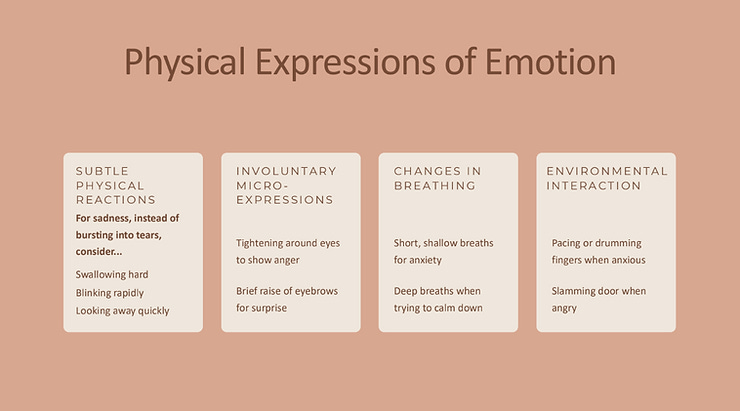
I recommend watching the full lecture3 and seeing what other lectures Authors Publish has available. There is probably something for everyone.
Writing without a paywall is important to me, but writing is work. If you enjoyed this post or found it helpful, I would be honored if you would consider donating.
In case you’re interested in watching the free lecture yourself: Writing Emotion — The Heart of the Story.
But maybe, like, in a healthy way, and you convince them to give away most of their money so they’re no longer a soulless billionaire
Once again: Writing Emotion — The Heart of the Story.
I’ve been thinking a lot about emotion and interiority as I develop my characters. Thanks for the lead on Authors Publish! Looks like a great resource.